Advocating for Those Left Behind: Gold Star Spouses Push for Survivor Benefit Reform
When a service member makes the ultimate sacrifice, the promise to their family should not end with their loss.
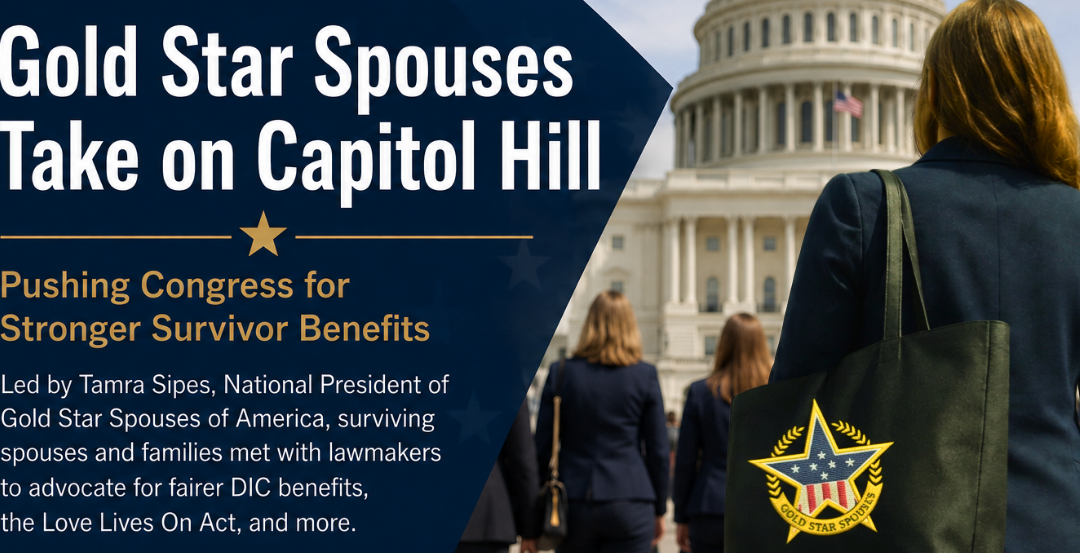
That is the message Tamra Sipes, National President of Gold Star Spouses of America, and dozens of surviving spouses and family members carried to Capitol Hill in April as they met directly with members of Congress to advocate for stronger and more equitable survivor benefits.
Their message was clear: military families who lose a loved one in service to our nation deserve a survivor benefit system that reflects the realities of today—not one that has fallen behind the needs of the families it was created to support.
According to Military.com, Sipes led a delegation of approximately 40–50 surviving spouses and family members to Washington, D.C., for meetings with lawmakers focused on improving Dependency and Indemnity Compensation (DIC) and other survivor benefits.
The Fight for Survivor Benefit Parity
At the center of the Gold Star Spouses’ advocacy is Dependency and Indemnity Compensation, commonly known as DIC.
DIC is a monthly, tax-free benefit available to eligible surviving spouses and dependents when a service member dies in the line of duty or a veteran dies from a service-connected condition.
But advocates say the benefit does not provide the same level of compensation available to survivors of federal civilian employees.
Sipes told Military.com that surviving spouses of federal civilian employees can receive approximately 55% of compensation, compared with approximately 43% for military surviving spouses. She estimated that the difference can amount to roughly $450 or more each month for some families.
For a family rebuilding its life after the loss of a service member, that difference can have a profound impact.
It can affect housing.
It can affect education.
It can affect child care.
It can affect the ability of a surviving spouse to remain in the workforce or build a business.
And it can affect a family’s ability to create a new sense of financial stability while navigating grief and an entirely different future than the one they had planned.
The Caring for Survivors Act
One of the major legislative priorities highlighted during the Capitol Hill advocacy effort is the Caring for Survivors Act.
The legislation seeks to increase DIC payments and bring military survivor benefits closer to the level provided to surviving families of federal civilian employees.
For Gold Star spouses, this is about more than a percentage or a line item in the federal budget.
It is about parity.
It is about recognizing that the families of service members who die because of their service should not face a financial disadvantage simply because their loved one wore a military uniform.
Sipes and Gold Star Spouses of America are asking Congress to recognize that distinction and take action.
The Sharri Briley and Eric Edmundson Veterans Improvement Act
Gold Star Spouses are also advocating for H.R. 6047, the Sharri Briley and Eric Edmundson Veterans Improvement Act.
The legislation addresses several areas of veterans and survivor benefits, including increases to DIC and Special Monthly Compensation for veterans with severe service-connected disabilities. It also includes provisions related to aid and attendance and VA home loan funding.
The legislation carries a deeply personal connection for the survivor community.
Sharri Briley, whose husband was killed during the 1993 Black Hawk Down mission in Somalia, is among the families connected to this advocacy effort.
These aren’t abstract policy debates.
Behind every benefit is a family.
Behind every number is a spouse, child, parent, or loved one whose life changed forever.
The Love Lives On Act and the Remarriage Penalty
Another major priority is the Love Lives On Act, bipartisan legislation designed to address what advocates call the military survivor “remarriage penalty.”
Under current rules, certain surviving spouses can lose important benefits if they remarry before reaching the applicable age threshold. The Love Lives On Act would allow surviving spouses to remarry without losing these earned benefits.
The issue has gained significant attention because surviving spouses can be forced into an impossible choice: protect financial and health benefits for themselves and their children, or move forward with a new marriage and potentially lose those benefits.
For younger surviving spouses, many of whom are raising children, this can create an especially difficult financial and emotional dilemma.
A survivor should never have to choose between rebuilding a life and maintaining the benefits their family earned through service and sacrifice.
Advocacy Is More Than a Meeting
On April 21, Gold Star Spouses and family members moved from congressional office to congressional office, meeting with lawmakers and congressional staff to explain the realities of survivor benefits.
The schedule included numerous short meetings, as well as drop-in visits designed to reach as many congressional offices as possible. The advocacy day concluded with a congressional reception where Gold Star Spouses of America presented Congressional Champion Awards to lawmakers who have supported survivor benefit legislation.
This is what advocacy looks like.
It is showing up.
It is sharing personal stories.
It is explaining complicated policy in terms of its real-world impact.
And it is reminding elected officials that legislation has consequences for real families.
Sipes described the effort as an education process as much as an advocacy effort, noting that lawmakers may not always understand the disparities in the survivor benefit system until surviving families explain them directly.
From Remembrance to Action
The Gold Star Spouses’ presence in Washington was also about remembrance.
During their visit, members gathered at Arlington National Cemetery to lay a wreath at the Tomb of the Unknown Soldier.
That ceremony and the Capitol Hill advocacy were separate events, but together they represented something powerful:
Honor the fallen. Support the living. Advocate for the families left behind.
Gold Star families carry the legacy of their loved ones every day.
Their advocacy ensures that remembrance does not remain symbolic—it becomes a call to action.
Why This Matters to the Military Spouse Community
The Military Spouse Chamber of Commerce believes strongly in ensuring that military spouses have the opportunity to build sustainable lives, careers, businesses, and futures.
That commitment includes recognizing that the military spouse community is not one-size-fits-all.
Military spouses experience different chapters of military life.
Some are navigating a PCS.
Some are building businesses.
Some are raising children through deployments.
Some are transitioning out of military service.
And some are rebuilding their lives after the loss of their service member.
Gold Star spouses are military spouses, too.
Their economic security, access to benefits, ability to work, ability to pursue entrepreneurship, and ability to build a future deserve a place in the national conversation about military spouse and family policy.
For entrepreneurs and business owners specifically, financial stability can determine whether a surviving spouse has the capacity to launch or sustain a business, pursue professional development, invest in their future, or provide stability for their children.
That makes survivor benefits an economic issue as well as a family policy issue.
Advocacy Works When We Use Our Voices
The work happening on Capitol Hill is a reminder that policy doesn’t change simply because a problem exists.
People have to speak up.
They have to share their stories.
They have to contact their representatives.
They have to build bipartisan coalitions.
And they have to continue showing up.
Gold Star Spouses of America is doing exactly that.
Their advocacy asks Congress to close gaps in survivor benefits, improve financial parity, and remove policies that can penalize surviving spouses for rebuilding their lives.
The Military Spouse Chamber of Commerce stands in support of continued efforts to strengthen policies that protect military families and recognize the sacrifices made by those who serve—and those who stand beside them.
Because when our nation asks a family to bear the unimaginable cost of losing a service member, our commitment to that family should be unwavering.
Read the full Military.com coverage of the Gold Star Spouses’ Capitol Hill advocacy effort. Read the Military.com article
Read Connecting Vets’ coverage of Gold Star Spouses bringing their survivor-benefit advocacy to Congress. Read the Connecting Vets article
Read the ‘Rebuild Lives’ after service-related death article. Read More at Stripes.com
To learn more about survivor-benefit advocacy and current legislative priorities, visit Gold Star Spouses of America and consider contacting your elected representatives about legislation affecting surviving military families.
Advocacy matters. Survivor voices matter. And the promise to military families must continue long after the uniform is laid to rest.
Recent Comments