
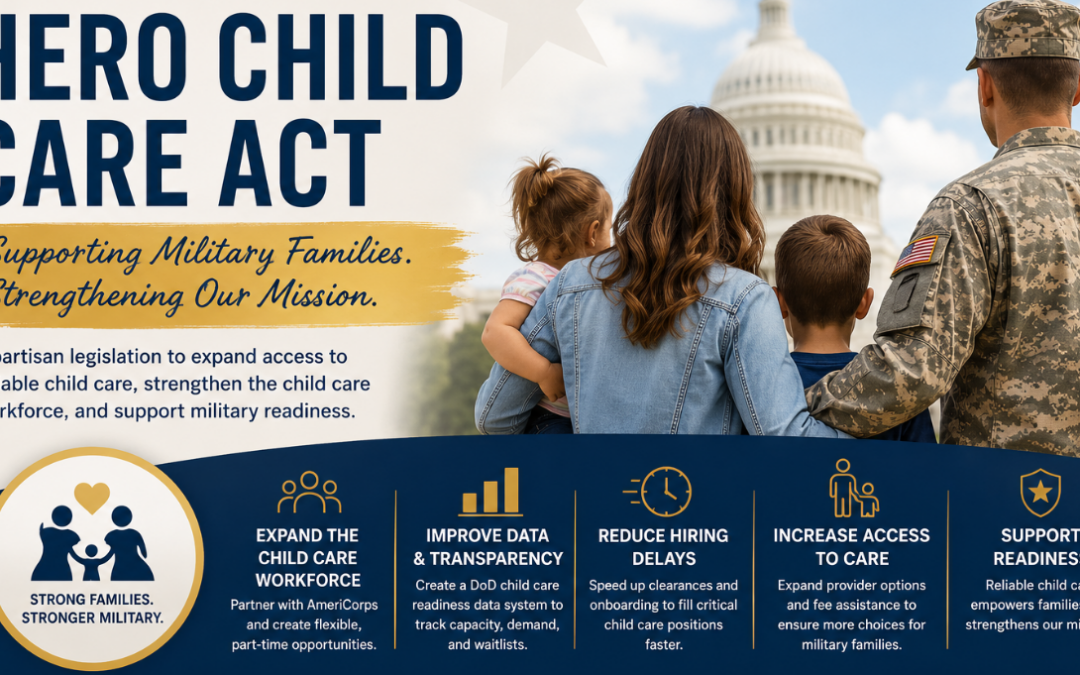
Bipartisan HERO Child Care Act Takes Aim at Military Family Child Care Challenges
For military families, access to reliable, affordable child care is more than a quality-of-life issue—it is a workforce, family stability, and military readiness issue.
On April 16, 2026, U.S. Senators Jeanne Shaheen (D-NH) and Joni Ernst (R-IA) joined with Representatives Jen Kiggans (R-VA) and Sara Jacobs (D-CA) to introduce the bipartisan, bicameral HERO (Helping Ensure Reliable Opportunities) Child Care for Military Families Act.
The legislation seeks to address some of the persistent challenges military families face when accessing Department of Defense child care, including long waitlists, staffing shortages, hiring delays, limited provider capacity, and a lack of comprehensive data about child care needs across the military community.
Why Child Care Access Matters to Military Families
Military families navigate a unique set of circumstances that can make finding dependable child care particularly challenging.
Frequent relocations can mean starting over with new schools, new child care providers, new waitlists, and new communities. Deployments and training schedules can create additional challenges for families who need flexible care. At the same time, military spouses may be trying to maintain careers, build businesses, pursue education, or reenter the workforce following a move.
When reliable child care isn’t available, the impact can extend well beyond the immediate challenge of finding someone to care for a child.
It can affect a military spouse’s ability to work.
It can affect a family’s financial stability.
And it can affect a service member’s ability to focus on their mission.
As Rep. Jen Kiggans noted, reliable, high-quality child care is directly tied to the well-being of military families and military readiness.
What Would the HERO Child Care Act Do?
The legislation proposes several changes designed to expand the military child care workforce, improve data collection, reduce administrative delays, and increase access to care.
1. Expand the Child Care Workforce
The HERO Act would give the Department of Defense authority to partner with AmeriCorps, allowing AmeriCorps volunteers to serve as providers at DoD Child Development Centers.
Expanding the pool of qualified individuals who can support military child care facilities could help address staffing shortages that contribute to long waitlists.
2. Create a Military Child Care Readiness Data System
One of the most significant provisions would establish a first-of-its-kind DoD child care readiness data system.
The system would track information such as:
- Child care capacity
- Utilization
- Staffing levels
- Vacancies
- Workforce turnover
- Demand
- Waitlists
The legislation would also require the Department of Defense to collect comprehensive data on military child care waitlists and examine how child care availability affects the readiness of the Armed Forces.
For military families who have historically had to rely on word-of-mouth networks and social media groups to learn about available child care, better data could be an important step toward greater transparency and more effective planning.
3. Reduce Hiring Delays
The bill would allow for preclearance of child care employees at DoD Child Development Centers in an effort to expedite the hiring process.
According to the legislation’s sponsors, lengthy clearance and onboarding processes can contribute to employees leaving before they officially begin their positions.
Reducing those delays could help Child Development Centers fill vacancies faster and increase the availability of care for military families.
4. Create More Flexible Employment Opportunities
The HERO Act would also allow the Department of Defense to hire part-time child care providers at Child Development Centers.
This provision could have particular relevance for military spouses.
Not every military spouse can commit to a traditional 40-hour workweek. PCS moves, school schedules, caregiving responsibilities, entrepreneurial pursuits, and other demands can make part-time employment a more realistic option.
The legislation specifically identifies military spouses as a potential pool of providers who may be unable to commit to full-time child care work but could participate in part-time opportunities.
That is an important recognition: military spouses aren’t simply beneficiaries of the military child care system—they can also be part of the solution.
5. Strengthen Recruitment and Retention
The bill would provide limited Morale, Welfare and Recreation (MWR) access to DoD child care employees, including commissary and exchange access.
The goal is to strengthen recruitment and retention by providing eligible child care employees with additional on-base benefits.
6. Expand Provider Options
The legislation would also expand eligibility for child care providers participating in the DoD’s fee assistance program, with the goal of increasing the number of child care options available to military families.
Why This Matters for Military Spouses
A spouse’s ability to work, launch a business, maintain a career, pursue education, or grow professionally is influenced by the infrastructure surrounding the military family—including child care, employment opportunities, licensing, access to resources, and community support.
For military spouse entrepreneurs, child care can be particularly important.
Building a business requires time, consistency, networking, client engagement, professional development, and the ability to respond to opportunities when they arise. When dependable child care is difficult to find, those opportunities can become much harder to pursue.
The HERO Act’s inclusion of flexible part-time child care providers could also open additional employment pathways for military spouses while simultaneously helping address staffing shortages.
That potential intersection between military family support and military spouse employment deserves continued attention.
Bipartisanship Matters
The HERO Child Care Act is also notable because it brings together lawmakers from both sides of the aisle and both chambers of Congress.
Senators Jeanne Shaheen and Joni Ernst are leading the legislation in the Senate, while Representatives Jen Kiggans and Sara Jacobs are leading the effort in the House.
For military families, bipartisan collaboration is particularly important. The challenges surrounding military child care are not partisan. They are experienced by families across branches, ranks, duty stations, and communities.
Addressing them requires sustained attention—and solutions that recognize the realities of military life.
Child Care Is Readiness
The conversation around military child care is often framed as a family benefit.
It is that.
But it is also much more.
Child care is readiness.
When a service member knows their children are safe and cared for, they can better focus on their responsibilities. When a military spouse has reliable child care, they have greater ability to work, build a business, pursue education, or contribute to their family’s financial stability.
And when military installations have sufficient child care capacity, they strengthen the overall infrastructure that allows military families to serve and thrive.
The HERO Child Care Act recognizes that connection.
Military families shouldn’t have to choose between serving their country, building their careers, and finding reliable care for their children.
That is why continued advocacy for accessible, affordable, flexible, and dependable military child care matters.
For the Military Spouse Chamber of Commerce, this legislation represents an important step toward recognizing that military family child care is directly connected to military readiness—and to the economic mobility of military spouses.
Learn More
Read the official announcement from Senator Jeanne Shaheen’s Office.
Read Senator Joni Ernst’s announcement.
Read Representative Jen Kiggans’ announcement.
Recent Comments